


In the Seattle area and across the PNW, soft wash roof cleaning is the safest way to remove moss in our damp, shaded climate without stripping the life out of your shingles. If you want a local breakdown of what works (and what doesn’t), start with our Redmond roof cleaning guide, and for manufacturer-backed info on asphalt shingle systems, see ARMA.
The science tells a different story.
While bleach does eliminate moss and algae on contact, it comes with hidden costs that most homeowners don't discover until years later: when their roof fails prematurely. If you're considering bleach for your Pacific Northwest roof, here's what you need to know about what's actually happening to your shingles.
What Bleach Actually Does to Asphalt Shingles
Bleach (sodium hypochlorite) is a powerful oxidizer. That's the chemical property that makes it effective at breaking down organic matter like moss, algae, and mildew. But here's the catch: asphalt shingles aren't just inert slabs of material sitting on your roof. They're engineered composites.
Modern asphalt shingles are saturated with essential oils and resins. These compounds serve a critical purpose: they keep your shingles flexible, waterproof, and able to expand and contract with temperature changes. In the Pacific Northwest, where we experience frequent freeze-thaw cycles and dramatic weather swings from Kirkland to Everett, that flexibility is non-negotiable.
When bleach is applied to a roof, it doesn't just sit on the surface. It penetrates the shingle matrix and begins oxidizing those protective oils and resins, drawing them out of the asphalt. This process effectively dehydrates the shingle from the inside out.

The Three Types of Damage You Need to Understand
1. Accelerated Granule Loss and Brittle Shingles
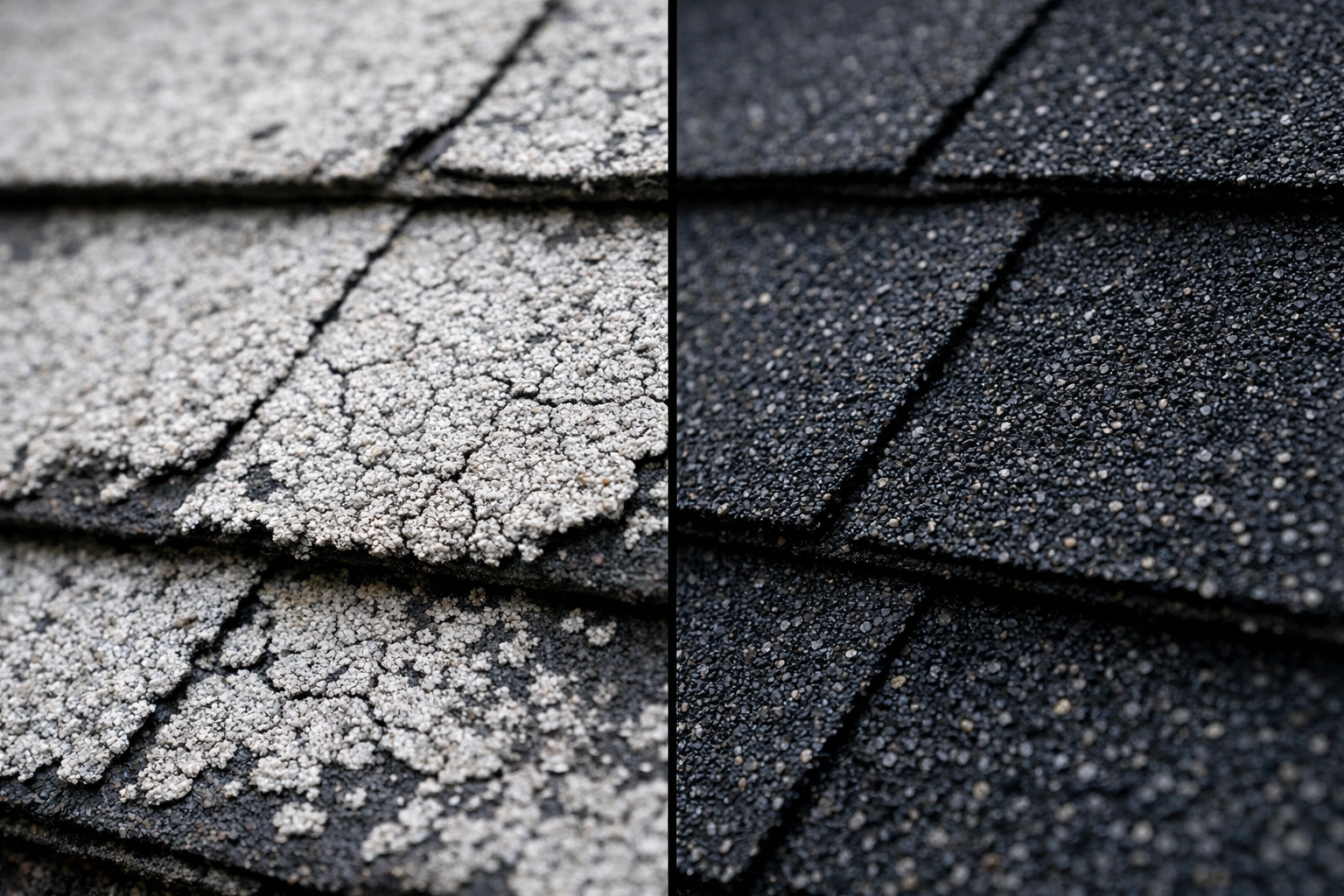
The protective granules on your shingles aren't just decorative: they shield the underlying asphalt from UV radiation and physical wear. When bleach strips away the oils that bind those granules to the shingle, the bond weakens. You'll start to see:
- Granules washing into your gutters after rainstorms
- Bald spots appearing on the roof surface
- Shingles that crack or break easily underfoot during inspections
Once the granules are gone, the asphalt layer is exposed to direct sunlight and weather. Degradation accelerates rapidly. What should have been a 25-year roof might fail in 15.
2. Loss of Flexibility in Temperature Swings
Dehydrated shingles lose their ability to flex. In Redmond, Bothell, and Woodinville, we see dramatic temperature shifts: especially during February's freeze-thaw cycles. Healthy shingles expand and contract without issue. Brittle, oil-depleted shingles crack, curl at the edges, and develop micro-fractures that compromise the roof's waterproof barrier.
This is compounded if moss is still present. Moss acts like a biological sponge, holding moisture against the shingle. When that moisture freezes and expands, it pries up shingle edges. If the shingle is already brittle from bleach exposure, the damage is exponential.
3. Collateral Damage Beyond the Roof
Bleach doesn't stop at your shingles. Runoff can cause several issues:
- Landscape damage: Bleach is toxic to plants. If it runs off your roof and into flower beds or landscaping, you're looking at dead shrubs, discolored grass, and potential soil contamination.
- Metal corrosion: Roof components like flashing, gutters, and fasteners are often metal. Bleach accelerates corrosion, especially on galvanized steel and aluminum. This increases the risk of leaks at critical junctions.
- Odor and irritation: Chlorine bleach releases fumes that can be unpleasant or even hazardous during application, especially in poorly ventilated areas or near open windows.
Many homeowners don't factor these risks into the "savings" of a DIY bleach treatment.

Why "Dilute It Properly" Isn't Enough
You'll find advice online suggesting that a properly diluted bleach solution (50/50 or 25/75 bleach-to-water) minimizes the risk. While dilution reduces immediate damage, it doesn't eliminate the oxidation process. You're just slowing it down.
Even at lower concentrations, bleach still penetrates the shingle and begins breaking down those protective oils. The damage may not be visible for a year or two, but it's accumulating beneath the surface. By the time you notice curling, cracking, or premature wear, the chemical process has already compromised your roof's structural integrity.
And here's the other issue: most homeowners don't have the equipment or expertise to ensure even, controlled application. High-pressure washing: often paired with bleach treatments: compounds the damage by physically dislodging granules and forcing water under shingle seams.
The RoofRX™ Difference: Bleach-Free, Maintenance-First Soft Wash Roof Cleaning
At Hydra Clean, we built RoofRX™ specifically for soft wash roof cleaning in the Seattle-area climate. It’s a proprietary, bleach-free treatment designed to eliminate moss, algae, and biofilm at the root without the harsh oxidation, fumes, or plant damage that come with sodium hypochlorite.
Here’s what makes RoofRX™ structurally different:
- Bleach-free chemistry: RoofRX™ doesn’t rely on harsh bleach to “shock” growth. It’s designed to clean and treat without dehydrating shingles or pulling out essential oils/resins.
- No pressure washing on roofs: We apply solutions with calibrated soft-wash equipment. The chemistry does the work, not high pressure that can dislodge granules or push water under seams.
- Maintenance-based approach: Consistent light treatments beat waiting for heavy buildup. You protect shingle flexibility, reduce regrowth cycles, and avoid the need for aggressive repeat cleanings.
- Certified technicians + safety focus: Our crews are trained and safety-certified, because roof work is high-risk and the details matter.
- Workmanship warranty: We back the work with an workmanship warranty. If you’re not happy with the results, you don’t pay. Period.

What to Expect When You Choose Bleach-Free
Switching to a bleach-free approach doesn't mean sacrificing effectiveness. Here's what the process looks like:
-
Assessment: We evaluate your roof's condition, moss density, and any areas of concern. For complex projects: like cedar shake, tile roofs, or commercial buildings: we'll deploy drone inspections to get a full picture. For most standard residential jobs, we move directly into cleaning.
-
Application: Our technicians apply the RoofRX™ solution using calibrated soft-wash equipment. The formula is allowed to dwell on the surface long enough to penetrate moss and biofilm, then rinsed away with controlled, low-pressure water.
-
Post-treatment protection: Unlike bleach, which leaves behind no residual protection, our system includes a treatment layer that discourages rapid moss regrowth. You'll see longer intervals between cleanings.
-
Maintenance approach: We recommend scheduling roof cleanings every 2 to 3 years in the Pacific Northwest, depending on your tree coverage and sun exposure. Preventative maintenance is always more cost-effective than emergency repairs.
Get Your Accurate Price in Under 2 Minutes
No waiting around for contractor callbacks. No high-pressure sales pitches. We built a custom quote calculator that gives you an accurate roof cleaning price instantly.
Just answer 4 to 5 quick questions about your home, and you'll get your price in 1 to 2 minutes. No gimmicks, no surprises.
We serve homeowners throughout the Greater Seattle area, including Bellevue, Redmond, Kirkland, Bothell, Woodinville, Shoreline, Lynnwood, Everett, Mill Creek, Sammamish, and now Bellingham and Whatcom County.
The Bottom Line
Bleach works: but at what cost? If you're looking at your roof as a long-term investment (which it is), the tradeoff isn't worth it. Stripping protective oils, accelerating granule loss, and risking collateral damage to your landscaping and metal components might save you a few dollars today, but it will cost you thousands in premature roof replacement down the road.
Choose a cleaning method that protects your investment. Choose a system backed by science, not just tradition. And if you're in the Pacific Northwest, choose a team that understands the unique demands of our climate.
Your roof does more than keep the rain out; it protects everything underneath. Treat it accordingly.